
Most event organizers assume hiring security guards means booking a few people to stand near the entrance. That assumption misses most of what a licensed event security engagement actually covers.
A real event security plan starts before a single guard arrives on site, and it continues through the last guest leaving the building.
Hiring event security guards includes far more than physical presence. It covers risk assessment, licensed staffing, access control, and incident response, all built around your specific venue and guest count.
This guide breaks down what you actually get when you hire security guards for your event in New York City, why each piece matters, and where organizers get it wrong.
Event Security Simply Explained
Event security is a coordinated plan built around your venue, guest count, and risk level, delivered by guards individually licensed with New York State.
- What the Service Actually Covers
Event security refers to the full set of services a licensed provider delivers to protect guests, staff, and property during a scheduled gathering. This includes entry screening, crowd monitoring, conflict de-escalation, and coordination with venue staff and vendors.
“Every guard assigned to your event must be individually registered with the New York State Department of State, a process that includes fingerprinting, background checks, and completion of a state-mandated training course.”
This licensing requirement applies regardless of whether the event is a corporate gala, a retail launch, or a nightclub takeover, and it applies to every guard on the roster, not just a supervisor or team lead.
- What a Guard Does On-Site
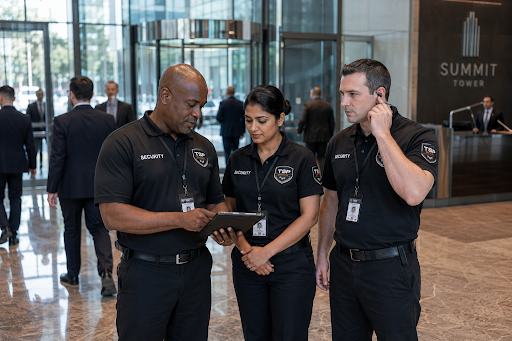
A licensed guard does more than watch a door. On a typical event, guards check bags at entry points, monitor crowd density in high-traffic zones, verify guest lists against RSVPs, and coordinate radio communication with venue management throughout the night.
Many providers also assign a designated point of contact who stays in direct communication with your event manager from setup through breakdown.
What’s Included When You Hire Event Security Guards
A complete event security engagement includes pre-event planning, on-site staffing, and post-event documentation, not just guards on the day.
Most providers advertise “event security” as a single line item. What that line item should include rarely gets explained anywhere, which leaves organizers guessing at what they are actually paying for.
- Pre-Event Risk Assessment and Staffing-Ratio Planning
Before any guard is assigned, a licensed provider evaluates your venue layout, expected guest count, alcohol service, and entry and exit points. This assessment determines how many guards you need and where they should be positioned.
“Industry guidance from ASIS International, the global association for security management professionals, outlines structured planning steps for organizing large events, including venue assessment and staffing calculations tied to crowd density.”
Skipping this step is the most common reason event security fails when something unexpected happens.
- Access Control, Vendor Coordination, and Incident Response
A full event security package also covers:
- Access point management, including credential checks and restricted-area enforcement
- Coordination with caterers, vendors, and production crews moving equipment in and out
- A documented incident response protocol for medical situations, altercations, or evacuations
- Post-event reporting that records any incidents for your records
These components rarely appear as a clear checklist when organizers research providers, which is exactly why they get overlooked until something goes wrong mid-event.
Why This Matters for NYC Event Organizers
Skipping any part of the full scope creates legal exposure and inconsistent coverage, two risks NYC organizers cannot afford at high-traffic venues.
- Legal and Liability Exposure
Event organizers carry legal responsibility for what happens on their premises. If a guard is unlicensed or a provider is uninsured, the organizer absorbs the liability if an incident occurs.
“Confirming registration status with the New York State Department of State before signing a contract protects you from this exposure, since an unregistered agency cannot legally provide guards in New York State.”
Confirming vendor compliance also matters at the city level.
“NYC Business requires both armed and unarmed guards to complete registration before working an assignment, and event organizers can verify this status before a contract is signed rather than discovering a gap after an incident occurs.”
- The Cost of Inconsistent Coverage
Inconsistent coverage creates a second risk. A provider that sends different guards to every shift, with no continuity in training or venue familiarity, cannot maintain the same level of crowd awareness a dedicated team builds over multiple events at the same location.
Guests notice this inconsistency too, since unfamiliar guards tend to react slower to developing situations than a team that already knows the venue’s layout and pressure points.
Common Misconceptions About Hiring Event Security
More guards and generic licensing do not guarantee better protection; the right staffing model and specialization matter more than headcount alone.
- “More Guards Always Means Better Coverage”
Adding guards without a staffing plan often creates confusion rather than safety.
A risk-based staffing model places the right number of guards at the right pressure points, such as entry lanes and bar areas, instead of spreading a large headcount evenly across a space that does not need it everywhere. Extra guards without a defined role also add cost without adding measurable protection.
- “Any Licensed Guard Can Handle an Event”
A guard licensed for office building security is not automatically prepared for crowd management in a nightlife or large public gathering setting.
Hospitality and nightlife events require guards trained specifically in de-escalation, alcohol-related conflict handling, and guest experience, skills that differ from static facility patrol work.
Organizers who assume all licensed guards are interchangeable often discover the gap only after a conflict escalates faster than the team on-site can manage.
How Total Service Provider Approaches Event Security
Total Service Provider builds a customized, contract-based security plan for each event, staffed with military-trained guards available around the clock.
- A Customized, Contract-Based Plan for Every Venue
Total Service Provider designs each event security plan around the specific venue, guest count, and risk profile rather than applying a standard package to every client.
This customized, contract-based approach allows organizers to scale staffing up or down based on the event type, from a corporate reception to a large public gathering.
- Trained Personnel, Available Around the Clock
Guards deployed for event assignments bring military and law enforcement training, giving organizers a disciplined, consistent standard of coverage across every shift.
Total Service Provider maintains 24/7 availability across all service lines, so event coverage extends to setup, the event itself, and breakdown.
“Exceptional public security service. Their team handled crowd control and entry management professionally throughout our tour. We felt completely confident having them on-site from start to finish.” —Sandra Mitchell, Crowd Control & Risk Management client
Frequently Asked Questions (FAQs)
Q1. How many security guards do I need for a 200-person event in NYC?
The right number depends on venue layout, alcohol service, and entry points, not guest count alone. A licensed provider typically assesses these factors during a pre-event risk assessment before recommending a staffing ratio.
Q2. Is event security guard hire covered by insurance liability?
A fully licensed and insured security provider carries liability coverage that protects both the guard and the organizer during an incident. Always confirm insurance and bonding status before signing a contract, since unlicensed providers leave organizers exposed.
Q3. Do I need a licensed security company for a private event in the Bronx or Manhattan?
Yes. New York State requires every security guard to be individually registered with the Department of State, regardless of whether the event is private or public, or which borough it takes place in.
Q4. How far in advance should I book event security guards?
Booking several weeks ahead gives a provider time to complete a proper risk assessment and assign guards familiar with your venue type. Last-minute bookings often skip the planning stage entirely.
Q5. What is the difference between crowd control and general event security?
Crowd control focuses specifically on managing guest density, flow, and entry and exit points during high-traffic moments. General event security covers the broader scope, including access control, conflict response, and coordination with venue staff throughout the event.
Final Thoughts
Hiring event security guards involves far more than staffing a door. A complete plan covers risk assessment, licensed personnel, access control, and incident response, all tailored to your venue and guest profile.
Skipping any of these pieces leaves organizers exposed to liability and inconsistent coverage on the day that matters most.
Request a customized security consultation with Total Service Provider to build a plan around your next event.