

Choosing between short-term and long-term executive protection in NYC depends on how long the risk will last. A one-time public appearance may need temporary coverage, while recurring travel, public exposure, or an ongoing threat may require a standing security detail.
In this guide, you’ll learn how short-term and long-term contracts differ, what each option suits best, and how to match your coverage to your business’s actual risk timeline.
Quick Answer: Short-term protection suits defined events or temporary threats. Long-term protection is better for ongoing or recurring executive risk.
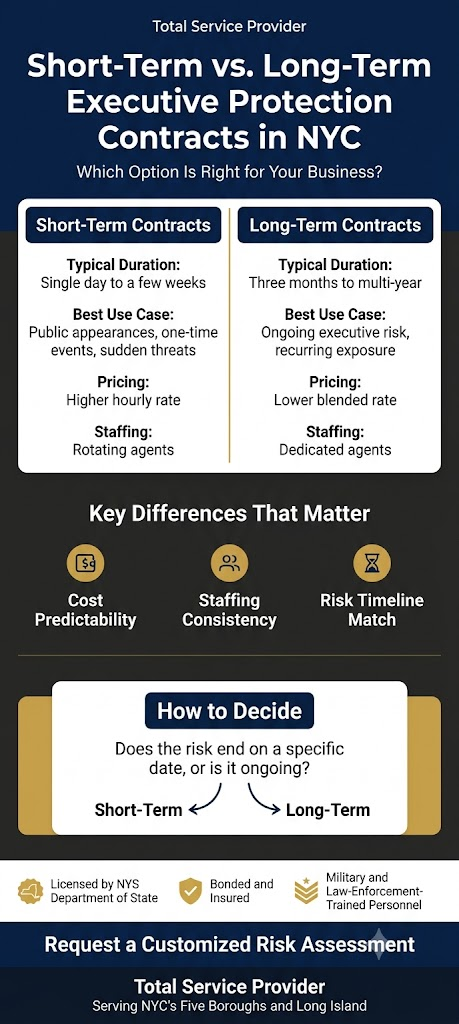
Short-Term vs. Long-Term Executive Protection Contracts NYC at a Glance
Quick Answer: The right contract type depends on how long your risk lasts, not how much you want to spend upfront.
| Factor | Short-Term Contract | Long-Term Contract |
| Typical duration | Single day to a few weeks | Three months to multi-year |
| Best use case | Public appearances, one-time events, sudden threats | Ongoing executive risk, recurring public exposure |
| Pricing structure | Higher hourly or per-day rate | Lower blended rate with volume commitment |
| Staffing continuity | Rotating agents based on availability | Dedicated agents familiar with the principal |
| Licensing and bonding | Full NYS DOS compliance required | Full NYS DOS compliance required |
What Short-Term Executive Protection Contracts Offer
Quick Answer: Short-term contracts give you fast, fully licensed coverage without committing to a standing detail you may not need again.
Short-term contracts work best for a defined window of risk. A single public appearance, a product launch, or a temporary threat spike does not require a year-long commitment.
Total Service Provider builds these contracts around a risk assessment completed before deployment. Trained agents are then assigned for the exact duration the event requires.
●Best-fit scenarios for short-term coverage
Businesses use short-term executive protection for board meetings open to the public, celebrity or executive appearances, and periods immediately following a specific threat.
Sandra Mitchell, a public tour organizer in Manhattan, described the experience this way: “Exceptional public security service. Their team handled crowd control and entry management professionally throughout our tour. We felt completely confident having them on-site from start to finish.”
●What buyers get wrong when choosing short-term coverage
Many buyers assume short-term means lower standards. It does not.
Every guard deployed under either contract type must complete registered training under Article 7-A before working a shift, according to the New York State Department of State. A short booking window never reduces the licensing requirement.
What Long-Term Executive Protection Contracts Offer
Quick Answer: Long-term contracts build continuity, letting the same trained agents learn a principal’s routine and reduce blind spots over time.
Long-term contracts suit executives, corporate leadership, and high-profile individuals facing ongoing exposure rather than a single event.
David Reyes, a corporate facilities manager, put it plainly: “We’ve relied on Total Service Provider for our office building security for years. Their team is punctual, and disciplined and consistently maintains a safe environment for our staff and visitors.”
●Best-fit scenarios for long-term coverage
Recurring public exposure, daily commutes, and standing corporate leadership risk all call for a retained detail rather than repeated one-off bookings.
A new minimum wage schedule for security guards takes effect on January 1, 2027, according to the NYC Department of Consumer and Worker Protection. Locking in a long-term contract rate before the change takes effect protects your budget.
●How agent continuity improves protection quality
A dedicated long-term team learns a principal’s schedule, property layout, and travel patterns. That familiarity catches deviations a rotating short-term team would miss.
The global private security services market is valued at 8.74 billion dollars in 2026 and is projected to reach 12.72 billion dollars by 2030, as per The Business Research Company. That growth reflects rising demand for both event-based and retained protection details.
The Key Differences That Matter
Quick Answer: The real trade-off is not price versus quality. It is flexibility versus continuity.
●Cost predictability
Short-term contracts cost more per hour. Long-term contracts trade a higher upfront commitment for a lower blended rate and predictable monthly budgeting.
●Staffing consistency
Short-term details may rotate agents based on scheduling. Long-term contracts assign dedicated agents who build familiarity with the principal. That familiarity reduces onboarding friction each time coverage begins.
●Match contract length to your risk timeline
Before signing either type, ask whether the risk applies to a single date or an ongoing condition. A one-time public appearance points to short-term coverage.
A standing corporate leadership role, recurring media exposure, or a documented ongoing threat points to a long-term detail. Businesses should also build in a reassessment point even inside a long-term contract, since risk levels change as a company grows.
A licensed watch, guard, or patrol agency must carry corporate bonding regardless of whether the assignment lasts one night or one year, according to the New York State Department of State. This requirement applies to short-term and long-term details alike.
Which Contract Option Is Best for You?
●Short-term contracts best fit event organizers and businesses facing a defined, time-limited exposure window.
●Long-term contracts best fit corporate executives and facility operators managing ongoing or recurring public-facing risk.
Frequently Asked Questions
●Can I switch from a short-term to a long-term executive protection contract?
Yes. Total Service Provider structures short-term engagements so they can convert into a long-term detail once a recurring risk pattern is confirmed, without restarting the licensing or onboarding process.
●Do short-term executive protection contracts require the same licensing as long-term ones?
Yes. New York State licensing, bonding, and insurance requirements apply equally regardless of contract length, since the agency and the individual guard both carry the obligation directly.
●How far in advance should I book short-term executive protection for an event?
Booking at least one to two weeks ahead allows time for a proper risk assessment and agent assignment, though Total Service Provider can accommodate faster deployments when a threat emerges suddenly.
●What happens if my long-term executive protection needs change mid-contract?
Long-term agreements include periodic reassessment points, allowing staffing levels or coverage hours to scale up or down as the executive’s public exposure or risk profile shifts.
●Is long-term executive protection more cost-effective than repeated short-term bookings?
For recurring or ongoing risk, yes. A retained contract typically carries a lower blended rate than booking multiple short-term engagements across the same period, while also keeping the same trained agents on assignment.
Choose the Right Executive Protection in NYC
Choosing between short-term and long-term executive protection in NYC depends on the duration and nature of the risk. Short-term coverage can suit a specific event or temporary threat, while long-term protection provides continuity for executives facing ongoing or recurring exposure.
Total Service Provider provides licensed, bonded, and insured security services tailored to your coverage needs. Contact Total Service Provider today to request a customized risk assessment and determine the right executive protection plan for your business.