

Search for nightclub security services and you find many different answers. Every provider calls itself the best fit, and every quote looks alike on paper. If you cannot tell which coverage model protects your venue, this guide helps you decide.
Risk-assessed coverage builds staffing around your venue’s risk level, schedule, and layout. Standard coverage places guards on fixed posts under a simpler scope.
For high-traffic, high-risk nights, the first model often fits the exposure better. Steady, low-risk venues may do well with the second. Read on to compare both and learn what to ask before you sign.
Standard coverage suits stable, low-risk venues, and risk-assessed coverage suits nightclubs and lounges with changing crowds, late hours, and VIP areas.
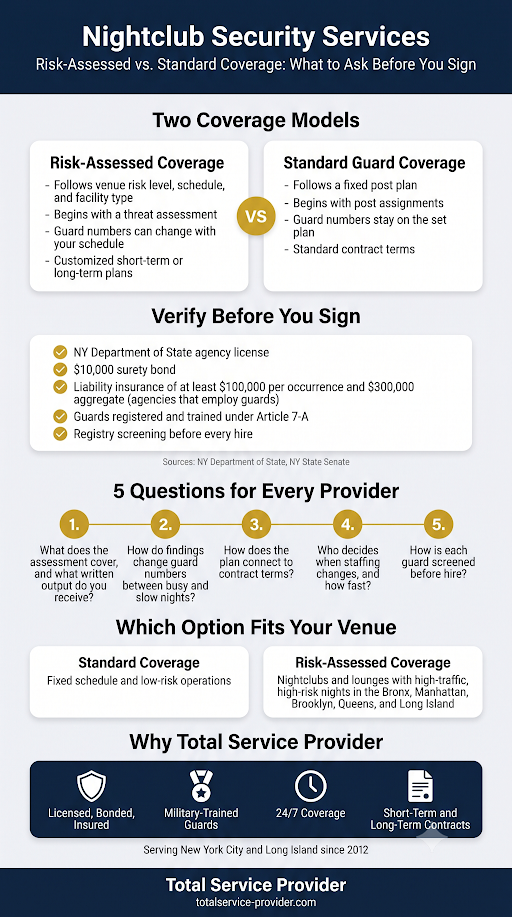
Side-by-Side: How the Two Coverage Models Differ
Risk-assessed coverage adapts to your venue, while standard coverage follows one post plan.
This table compares both models on five criteria that shape your hiring decision.
| Criterion | Risk-Assessed Coverage | Standard Guard Coverage |
| Staffing basis | Follows venue risk level, schedule, and facility type | Follows a fixed post plan |
| Start-up planning | Begins with a threat assessment | Begins with post assignments |
| Busy and slow nights | Guard numbers can change with your schedule | Guard numbers stay on the set plan |
| Compliance evidence | Ask for registration, bond, and insurance proof | Ask for registration, bond, and insurance proof |
| Contract structure | Customized short-term or long-term plans | Standard contract terms |
What Total Service Provider Delivers With Risk-Assessed Coverage
Total Service Provider builds nightclub coverage around your venue’s risk level and schedule, backed by state licensing, military-trained guards, and flexible contracts.
Risk-assessed coverage starts with a threat assessment of your venue. The provider then sets guard numbers, posts, and hours to match your facility type, schedule, and risk level.
Total Service Provider follows this customized model for its nightclub security services and adds crowd control and rapid incident response. You get a plan that fits your venue instead of a fixed template.
Verify Licensing, Bonding, and Insurance Before You Sign
Licensing, bonding, and insurance protect you when an incident happens on your floor.
The Total Service Provider holds a license from the New York State Department of State, Division of Licensing Services, and operates fully licensed, bonded, and insured. State licensing requirements cover the training, certification, and background checks for its guards.
“The New York Department of State lists a $10,000 surety bond and, for agencies that employ security guards, liability insurance of at least $100,000 per occurrence and $300,000 in the aggregate among the requirements for a Watch, Guard, or Patrol Agency license.”
“The New York Department of State states that Sections 89-G, 89-H, and 89-N of Article 7-A require all persons engaged in security guard activities to register with the department and complete training, unless exempt.
“The New York State Senate publishes Section 89-g of the Security Guard Act, which governs the employment of security guards.”
Next, ask every provider for its agency license details, its bond, its insurance certificate, and its guard registration process. Then request the same evidence in writing.
Turn the Provider’s Assessment Into Signed Coverage Commitments
An assessment helps only when it changes what you sign, so compare nightclub security services on that point. Ask how the provider turns assessment findings into staffing and contract terms before you commit. Put these questions to every provider:
- Ask what the assessment covers and what written output you receive.
- Ask how the findings change guard numbers and posts between busy nights and slow nights.
- Ask how the plan connects to contract terms, including short-term and long-term options.
- Ask who decides when staffing changes and how quickly that decision happens.
- Ask how the provider screens each guard before hire.
For the fifth question, “the New York Department of State Security Guard Registry states that employers must search an individual’s eligibility for hire in the online registry before hiring the candidate.”
Assessment details vary by venue, so request the specifics in writing. Total Service Provider tailors each security plan to the client’s facility type, schedule, and risk level, and it offers short-term and long-term agreements.
Review the details for your venue during a consultation.
Military-Trained Nightlife Guards on Flexible Contracts
Military-trained personnel with law enforcement backgrounds bring disciplined standards to the door and the floor. Guards handle crowd management, conflict resolution, and guest safety at restaurants, bars, lounges, and nightclubs.
Coverage runs 24/7, and contracts run short-term or long-term, so you avoid rigid commitments.
Marcus Allen, a client in Hospitality & Nightlife Security, says:
“The Total Service Provider has been outstanding for our venue. Their guards are professional, well-trained, and know exactly how to manage our crowd without disrupting the guest experience.”
What Standard Guard Coverage Offers
Standard coverage follows a fixed-post plan with a simple scope.
They assign guards to set posts, such as the entrance, and they repeat that plan from night to night. The scope stays simple, and the structure stays familiar. However, a fixed plan does not change by itself when the crowd, the event, or the risk level changes.
Standard coverage works when your venue has steady traffic and low-risk operations. It also suits owners who want one clear post list and predictable staffing.
You can review that list at a glance, which keeps staffing decisions quick. Confirm the same license, bond, and insurance evidence with any provider.
The Key Differences That Matter for Your Venue
Standard coverage wins on simplicity, but risk-assessed coverage wins on fit and flexibility.
Difference 1: Simple Setup Versus Coverage That Tracks Your Risk
Yes, standard coverage is simpler to set up. But a fixed staffing plan leaves gaps when peak nights bring more risk than the plan expected. For example, a Saturday headliner, a private event, and a quiet Tuesday call for different guard numbers and posts.
Difference 2: Standard Terms Versus Contracts Built Around Your Schedule
Yes, standard contract terms look straightforward. But a plan built around your schedule lets you scale coverage to your calendar instead of committing to one rigid arrangement. Short-term agreements suit launches and single events, while long-term agreements suit steady weekly operations.
Which Option Is Best for You?
Match the coverage model to your venue’s schedule and risk level.
Best for Standard Coverage
Owners of venues with a fixed, low-variation schedule and low-risk operations who want a simple post-plan and predictable staffing.
Best for risk-assessed coverage from Total Service Provider
Nightclub and lounge owners or operations managers in the Bronx, Manhattan, Brooklyn, Queens, or Long Island who need compliant, flexible coverage for high-traffic, high-risk nights. These buyers want legal protection and liability coverage from a provider with verified licensing.
Frequently Asked Questions (FAQs)
These answers cover common questions before you sign.
Q1. What is risk-assessed nightclub coverage?
Risk-assessed coverage means the guard plan follows a review of your venue’s threats instead of a set template. Providers size the team, choose the posts, and set the hours from that review. Total Service Provider builds these plans around facility type, schedule, and risk level.
Q2. What should a nightclub security provider show before you sign?
Ask for the agency license from the New York State Department of State, proof of the surety bond, proof of liability insurance, and the guard registration process. The New York Department of State requires guards to register and complete training.
The Total Service Provider operates fully licensed, bonded, and insured.
Q3. Can you sign a short-term nightclub security contract?
Short-term agreements are available. Total Service Provider offers short-term and long-term plans, so you can match coverage to your schedule and needs.
Q4. Does Total Service Provider cover venues outside Manhattan?
Coverage extends to the Bronx, Brooklyn, Queens, and Long Island as well as Manhattan.
Q5. Is 24/7 coverage available for nightclubs?
Around-the-clock service is available. Total Service Provider offers 24/7 security services across all service lines.
The Bottom Line
Choose the coverage model that matches your venue’s risk, then confirm the provider’s license, bond, insurance, and assessment process in writing. Doing so keeps your guests, staff, and premises protected around the clock.
Total Service Provider has served New York City businesses since 2012 and has earned the satisfaction of 1,000+ clients. Its team delivers customized, contract-based nightclub security services across New York City and Long Island.
Request a consultation with Total Service Provider to review your venue and receive a customized proposal.