
When you search for a restaurant security guard, you get a dozen different answers. Every provider promises reliable coverage, and every proposal sounds the same. You still cannot tell which arrangement protects your dining room on a packed Saturday night.
The real question is consistency. Does the same guard cover your door every week, or does a new face arrive each shift? Inconsistent coverage at high-traffic venues frustrates owners, and your answer shapes your risk, your guest experience, and your contract.
This article compares dedicated and rotating coverage so you can decide before you sign. The short verdict: dedicated coverage fits busy, late-service venues, and rotating coverage fits low-risk, low-traffic ones.
Dedicated coverage suits restaurants with late service, heavy traffic, or crowd risk. Rotating coverage suits low-risk venues where guard familiarity matters less.
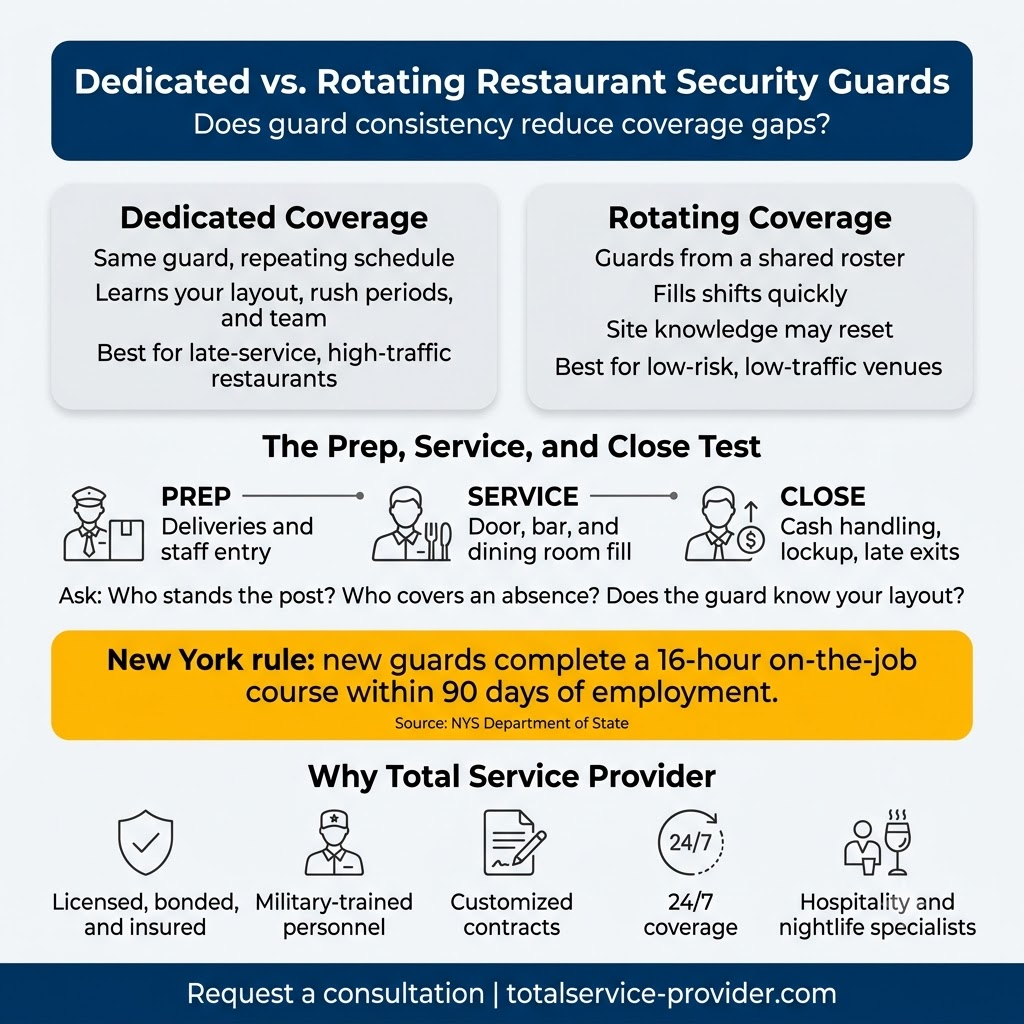
Dedicated vs. Rotating Guard Coverage
Dedicated coverage builds site knowledge over repeat shifts, while rotating coverage fills shifts from a wider pool of guards.
| Criterion | Dedicated coverage | Rotating coverage |
| Site familiarity | Builds across repeat shifts | May reset with each new placement |
| Absence coverage | Confirm the backup plan in writing | Filled from the roster pool |
| Onboarding | Concentrated at one venue | May repeat across several sites |
| Contract fit | Short-term and long-term plans | Varies by provider |
| Best use | Late-service, high-traffic venues | Low-risk, low-traffic venues |
Use this table as a screening tool. The right choice depends on your hours, traffic, and risk level.
What Total Service Provider Does Best for Restaurant Security Guard Coverage
Total Service Provider gives restaurants licensed, bonded, and insured guards and customized 24/7 coverage.
A dedicated restaurant security guard is a licensed guard who covers one venue on a repeating schedule.
A rotating guard comes from a shared pool and changes by shift. Dedicated coverage gives you a guard who knows your doors, rush periods, and team, which matters most at busy, late-service restaurants.
Criterion 1: Licensed, Bonded, and Insured Guard Personnel
The Total Service Provider operates under the New York State Department of State, Division of Licensing Services, and trains, certifies, and background-checks its guards under state requirements.
Full licensing, bonding, and insurance address the legal protection and liability concerns that come with hiring security staff.
“Under Article 7A of New York’s General Business Law, persons engaged in security guard activities generally must be registered with the New York Department of State and complete required training unless an exemption applies.”
Military-trained personnel with law enforcement backgrounds add disciplined standards to every post.
One hospitality client, Marcus Allen, describes the result:
“The Total Service Provider has been outstanding for our venue. Their guards are professional, well-trained, and know exactly how to manage our crowd without disrupting the guest experience.”
Criterion 2: The Service-Period Continuity Test, Checking Prep, Service, and Close
In practice, coverage gaps tend to open when shifts change. Treat that as an editorial observation, not measured data. Run this three-part test on every proposal.
First, check prep, when deliveries arrive and staff enter before opening. Next, check service when the door, bar, and dining room fill at once. Finally, check close when cash handling, lockup, and late departures create exposure.
For each period, ask who stands the post, who covers an absence, and whether that guard knows your layout. Dedicated coverage still needs a named backup, because any guard can call out.
“The New York State Department of State requires a new security guard to complete a 16-hour on-the-job course, relevant to the duties of guards, the requirements of the work site, and the needs of the employer, within 90 days of employment.”
That window means a new guard may still be building site knowledge during early shifts. This is an editorial observation, not a finding about any provider.
Criterion 3: Flexible, Customized 24/7 Contract Plans for Your Venue
Total Service Provider offers short-term and long-term agreements, so you avoid rigid commitments.
Each customized security plan starts with your facility type, your service hours, and your risk level. Its 24/7 security services cover overnight and late-night hours.
Explore the full range of security guard services.
What Rotating Coverage Offers
Rotating coverage assigns guards from a shared roster, which gives providers scheduling flexibility.
They assign guards from a shared roster, which lets a provider fill a shift quickly when demand changes. Yes, that speed helps, but it usually means the guard on your door changes from week to week.
They suit short, low-risk needs, such as a temporary gap in coverage. Yes, that fits a limited need, but it leaves site knowledge to whoever the roster sends.
They can cover a wide range of shifts, and they do not tie one guard to one venue. These points describe the general model, not any named provider.
The Key Differences That Matter for Guard Staffing
Consistency protects site knowledge and guest experience, and rotation trades both for scheduling flexibility.
Difference 1: Yes, Rotation Adds Flexibility, but Site Knowledge May Reset With Each Placement
Yes, rotation gives providers room to rebalance shifts. That flexibility usually means a new guard has to learn your layout on the job.
A guard who stays at your venue builds that site knowledge once, so you keep continuity where it counts.
Difference 2: Yes, Rotation Fills Shifts, but Guest Experience Depends on a Guard Who Knows Your Venue
Yes, rotation fills an empty shift. Your guests, however, judge the evening by how calmly the door and dining room run. Hospitality security calls for crowd management, conflict resolution, and guest safety without disrupting service.
Total Service Provider specializes in hospitality and nightlife security, so its guards arrive with that training. Learn more about its restaurant and nightlife security services.
Which Option Is Best for Your Restaurant?
Match the coverage model to your traffic, hours, and risk level.
Best for Rotating Coverage
A low-risk, low-traffic venue that needs occasional extra coverage and does not depend on guard familiarity.
Best for Dedicated Coverage
A late-service or high-traffic restaurant in the Bronx, Manhattan, Brooklyn, or Queens that needs consistent, licensed coverage from a guard who knows the venue.
Frequently Asked Questions About Dedicated Guard Coverage
Q1. What is a dedicated restaurant security guard?
A dedicated restaurant security guard is a licensed guard who covers one venue on a repeating schedule. The guard learns your layout, rush periods, and team. That familiarity helps the guard spot problems early and act calmly during busy service periods.
Q2. How soon must a new security guard finish on-the-job training in New York?
According to the New York State Department of State, “a new guard must complete a 16-hour on-the-job course within 90 days of employment, after an eight-hour pre-assignment course.”
The on-the-job course covers the guard’s duties, the work site, and the employer’s needs.
Q3. Can you change guard assignments under a flexible restaurant security contract?
Raise assignment preferences and schedule changes during your consultation.
Q4. Does Total Service Provider cover overnight and late-night restaurant service?
Yes. Its 24/7 security services cover restaurants, bars, lounges, and nightclubs.
Q5. What should you ask a security provider about guard consistency before signing?
Ask who stands at each post during prep, service, and close, and who covers an absence. Confirm licensing, bonding, and insurance.
“The Division of Criminal Justice Services notes that Article 7-A, section 89-n, exempts some guards from training requirements based on prior employment, so ask how each guard met them.”
The Bottom Line
Consistency separates coverage that looks good on paper from coverage that holds up on a busy night.
A restaurant security guard who returns to your venue learns it shift by shift, and that knowledge helps the guard act with confidence when a situation develops.
Before you sign, run the prep, service, and close test and ask every provider who covers each post. Then compare the answers against licensing, bonding, and insurance status. Total Service Provider has served NYC businesses since 2012.
Request a consultation with Total Service Provider for hospitality and nightlife security, and build your restaurant plan around your service hours.