

Event security should be planned before permits are filed, insurance is requested, or tickets go on sale. In New York City, choosing the right provider means checking agency licensing, guard registration, insurance, and event-specific staffing needs.
In this guide, you’ll learn what to look for when hiring event security in New York and how Total Service Provider can help manage entry, crowds, and event risks.
Quick Answer: Effective event security goes beyond staffing the door. Licensed security agencies, properly registered guards, appropriate insurance, and a site-specific crowd control plan help keep NYC events organized and secure.
What Event Security New York Actually Involves
Quick Answer: Event security combines entry screening, crowd flow management, and risk planning, and most booking mistakes come from skipping the compliance step entirely.
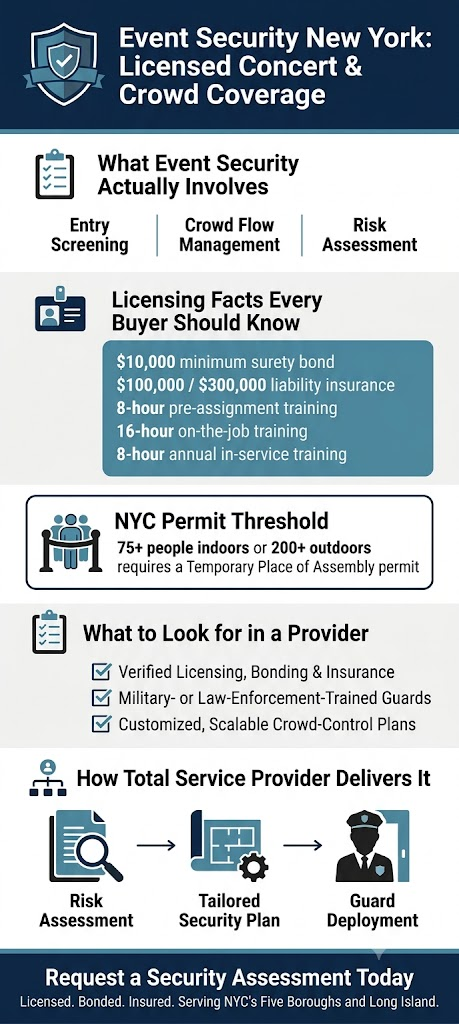
●Core Components: Entry Screening, Crowd Flow, and Risk Assessment
A concert or large public gathering needs more than guards standing at the door. Entry screening controls who comes in and what they bring.
Crowd flow management keeps people moving safely between entry points, stages, and exits. Risk assessment identifies choke points, medical needs, and emergency evacuation routes before the first guest arrives.
NYC tourism generated $84.7 billion in total economic impact in 2025, much of it tied to the concerts, festivals, and public gatherings that increasingly depend on coordinated security planning, according to NYC Tourism + Conventions.
●What Buyers Get Wrong When Choosing a Provider
Many organizers choose a provider based on hourly rate alone, without confirming the guard agency actually meets New York’s licensing standard.
Every security guard agency operating in New York must hold a surety bond of at least $10,000, and agencies that employ guards must also carry liability insurance of $100,000 per occurrence and $300,000 in aggregate coverage, according to the New York State Department of State.
Hiring an unlicensed or under-bonded provider shifts that liability directly onto the organizer.
The global private security services market is projected to grow from $5.4 billion in 2026 to $8.0 billion by 2030, according to Grand View Research. That growth means more new providers are entering the market without an established record of licensing compliance.
Licensing does not stop at the agency level.
Individual guards must also complete state-mandated training, including an 8-hour pre-assignment course, 16 hours of on-the-job training, and 8 hours of annual in-service training under Article 7A, Section 89-G, per the New York State Department of State.
A provider who skips this step is putting untrained staff in front of your crowd. Beyond licensing, most organizers overlook NYC’s permit requirement entirely.
Events where 75 or more people gather indoors or 200 or more gather in an outdoor space generally require a Temporary Place of Assembly permit from the city, according to NYC.gov.
A licensed security provider should be able to confirm whether your event meets this threshold and help align staffing with the permit conditions.
What to Look for in an Event Security Provider
Quick Answer: The right provider is licensed and insured, staffed with disciplined personnel, and able to scale a plan to your specific venue and crowd size.
●Criterion 1: Verified Licensing, Bonding, and Insurance Status
Ask for proof of active New York State security guard licensing before signing a contract. A provider that cannot produce current licensing, bonding, and insurance documentation is not a safe choice for a public-facing event, regardless of price.
●Criterion 2: Military- or Law-Enforcement-Trained Personnel
Concerts and large gatherings create unpredictable, high-pressure situations. Guards with military or law-enforcement training bring disciplined, situational-awareness-driven conduct that general staffing agencies rarely match.
●Criterion 3: Customized, Scalable Crowd-Control Planning
Every venue and crowd size is different. A provider should build a security plan around your specific event rather than applying the same staffing template to every job. It should also be able to scale coverage up or down as attendance changes.
How Total Service Provider Delivers Event Security in New York
Quick Answer: Total Service Provider builds a security plan around a risk assessment first, then deploys licensed, bonded, and insured guards trained to manage crowds without disrupting the event.
Total Service Provider starts every event engagement with an on-site risk assessment, not a generic staffing quote. This process identifies entry points, crowd density risks, and emergency response needs before a contract is finalized.
Every guard assigned to an event is licensed, bonded, and insured under New York State Department of State requirements. Every contract can flex between short-term and long-term terms depending on the event schedule.
●The Process Behind Every Deployment
Clients work through an initial risk assessment, followed by a tailored security plan and guard deployment matched to venue size and crowd volume. This keeps staffing proportional to actual risk instead of a flat per-hour headcount.
●Real Results from NYC Events
Sandra Mitchell, a public tour organizer in Manhattan, said, “Exceptional public security service. Their team handled crowd control and entry management professionally throughout our tour. We felt completely confident having them on-site from start to finish.”
Marcus Allen, a restaurant owner in the Bronx, added, “Total Service Provider has been outstanding for our venue. Their guards are professional, well-trained, and know exactly how to manage our crowd without disrupting the guest experience.”
Frequently Asked Questions
These are the questions NYC event organizers ask most often before booking security for a concert or large gathering.
●Does a concert in NYC legally require licensed security?
New York does not mandate security guards for every private event, but any guard agency you hire must be licensed, bonded, and insured under New York State Department of State rules, and larger venues often require proof of licensed security as part of their own permit or insurance conditions.
●What is the difference between event security and crowd control?
Event security covers the full scope of protecting an event, including entry screening and emergency response, while crowd control is one part of that scope focused specifically on managing how people move and gather within the venue.
●How far in advance should I book event security for a large NYC gathering?
Booking several weeks ahead gives a provider time to complete a risk assessment, confirm permit requirements, and build a staffing plan matched to your venue, rather than assembling coverage at the last minute.
●What size event requires a Temporary Place of Assembly permit in NYC?
Events with 75 or more people gathering indoors or 200 or more gathering in an outdoor space typically require a Temporary Place of Assembly permit from the city, according to NYC.gov.
Plan Event Security Before Your Guests Arrive
Concerts and large public gatherings need security that matches the venue, crowd size, and potential risks. Total Service Provider provides professional security services across the Bronx, Manhattan, Brooklyn, Queens, and Long Island, with customized support for crowd control, entry management, and event safety.
Ready to plan your event security in New York? Contact Total Service Provider today to request a security assessment and build a tailored security plan for your next event.