

How does security guard insurance protect businesses and property owners? Simply put, if a guard causes damage or someone gets hurt on your site, the insurance helps cover the cost, so it doesn’t come out of your pocket.
Most security companies say they’re insured. But that’s easy to claim and hard to check. And hiring your own guards may look simpler until you’re the one handling the insurance, training, and paperwork.
So which option is right for your NYC business?
Here’s a quick way to think about it:
Contracted security works well if you want licensed, insured guards without managing them as employees.
In-house security works better if you have the time and staff to register, train, insure, and supervise your own guards.
In this guide, we assess the two, including what Total Service Provider offers, so you can decide based on facts. We’ll also show you what to check in a policy before you sign anything.
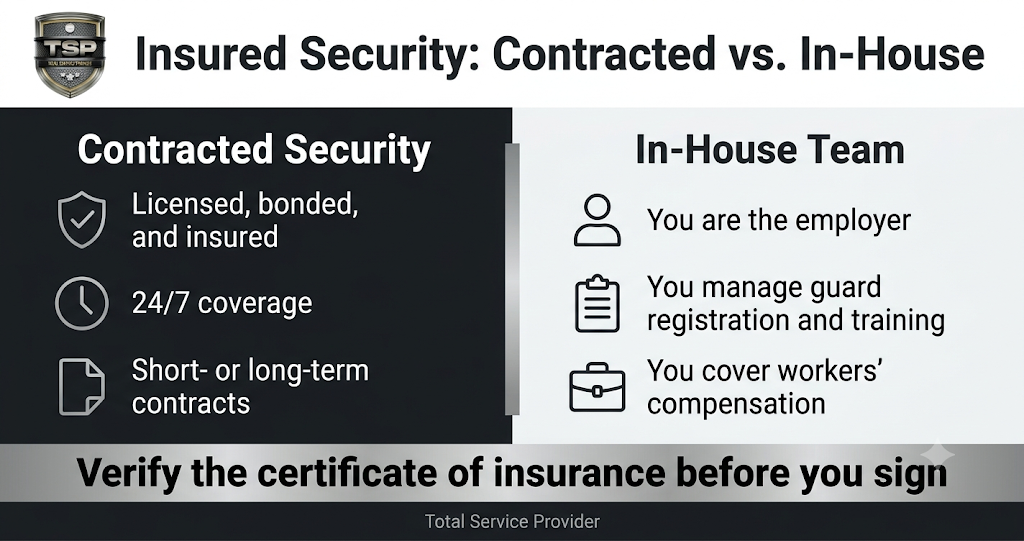
Contracted Security vs. In-House Teams
With contracted security, the provider handles licensing, insurance, and managing the guards. With an in-house team, all of that falls on you.
| Criteria | Total Service Provider | In-house team |
| Licensing | Licensed under the NYS Department of State, Division of Licensing Services | Guards must register with the Department of State and complete required training, unless exempt |
| Liability insurance | Fully licensed, bonded, and insured | State coverage rules for security guard companies may apply to you; confirm with the Department of State |
| Workers’ compensation | Ask the provider for proof of coverage | You cover guards you supervise as employees |
| Contract terms | Short-term and long-term agreements | Guards become your employees |
| Coverage hours | 24/7 security services | Depends on the shifts you staff |
How Security Guard Insurance Protects Businesses with the Total Service Provider
Security guard insurance protects you through the liability coverage sets by New York for security guard companies, and a contract with a licensed, bonded, and insured provider lets you ask for proof of that coverage before any guard starts work.
Policy terms decide what an insurer pays, so read the certificate of insurance before you sign.
Total Service Provider operates as a fully licensed, bonded, and insured security company. That status gives you a specific document to request instead of a marketing claim to trust.
Licensing and Registration You Can Verify
Total Service Provider holds a license from the New York State Department of State, Division of Licensing Services. Its guards meet state training, certification, and background-check requirements.
“The Department of State requires everyone engaged in security guard activities, unless exempt, to register and complete training: eight hours of pre-assignment training, 16 hours of on-the-job training within 90 days of employment, and eight hours of in-service training each calendar year.”
Training shows a guard is qualified for the job. Insurance shows you’re covered if something goes wrong.
Insurance Coverage to Request From Your Contractor
“New York General Business Law Section 89-G calls for comprehensive general liability coverage for death and personal injury.
Including false arrest or false imprisonment, malicious prosecution, libel, slander, and violation of the right of privacy, in the minimum amount of $100,000 per occurrence and $300,000 in the aggregate, with 30 days’ prior notice to the department before any modification or cancellation.”
In short, these are the minimum protections a provider should have, and you’re allowed to ask for proof.
Use those points when you review a proposal.
Ask for these items:
- A current certificate of insurance from the provider.
- Per-occurrence and aggregate limits that meet or exceed $100,000 and $300,000.
- Confirmation that the policy covers the claim types listed above.
- The 30-day notice provision for any change or cancellation.
- Flexible, 24/7 Contract Coverage
Total Service Provider builds customized security plans around your facility type, schedule, and risk level. You can choose a short-term or a long-term agreement, and coverage runs 24/7 across every service line.
James Carter, a nightclub operations director, describes the result:
“Their hospitality security team is exactly what our venue needed. They’re experienced, calm under pressure, and handle every situation with the right level of authority and professionalism.”
What In-House Security Teams Offer
An in-house team gives you direct supervision, and it makes you the employer of every guard.
Yes, that control is valuable, but it also means you manage registration timing and training schedules for each guard, including the 16-hour on-the-job course that guards must finish within 90 days of employment. You also cover those guards with workers’ compensation.
“Local Law 61 of 2026 phases in workplace protections for certain private-sector security guards in New York City, starting with a minimum wage on January 1, 2027.”
Check the city guidance to see whether your guards are covered. This model works for organizations with the administrative capacity to handle all of these steps.
The Key Differences That Matter
The main difference is who the law treats as the security guard company at your site.
Does Hiring Guards Directly Make You a Security Guard Company?
Generally, yes. Under New York’s Security Guard Act, a business that hires its own guards is still treated as a security guard company. The law makes this clear indirectly.
“Section 89-g exempts companies that use guards ‘solely for their own proprietary use’ from only one thing: the licensing enforcement rules in Article 7.”
That exemption would not be needed if in-house employers were not covered in the first place.
The exemption is narrow, though. The same section says a security guard company cannot knowingly employ a guard unless the required liability insurance is in force and the certificate is on file with the Department of State.
The state’s checklist for in-house employers also asks for proof of insurance and a designated security guard coordinator.
Workers’ Compensation Responsibility
“The New York Workers’ Compensation Board says virtually all employers in the state must provide workers’ compensation coverage and post notice of coverage in their places of business, and it notes that general contractors routinely require subcontractors to provide proof of their own coverage.”
Apply the same habit to a security provider: request proof of coverage in writing.
Which Option Fits Your Business?
The right choice depends on whether you want to manage guards as employees or buy licensed coverage.
- In-House Team: Best for organizations with a dedicated security director and the administrative capacity to register, train, insure, and supervise their own guards at one fixed site.
- Total Service Provider: Best for New York City restaurant, nightclub, office, retail, and event operators who want 24/7 licensed, bonded, and insured coverage under a customized contract without managing guards as employees.
Frequently Asked Questions (FAQs)
Q1. What insurance must security guard companies carry in New York?
New York General Business Law Section 89-G calls for comprehensive general liability coverage for death and personal injury. It must include false arrest or false imprisonment, malicious prosecution, libel, slander, and violation of the right of privacy.
The minimum is $100,000 per occurrence and $300,000 in the aggregate. Ask for the certificate of insurance before you sign.
Q2. Does hiring your own security guards make you a security guard company?
Section 89-G refers to companies that employ guards solely for their own proprietary use as security guard companies, with an exception from article seven enforcement. Because the insurance rules may apply to you, confirm your obligations with the Department of State before you hire.
Q3. How do you check a security company’s insurance before signing?
Ask for a certificate of insurance. Confirm the limits meet $100,000 per occurrence and $300,000 in the aggregate; the covered claim types match Section 89-G, and the certificate provides 30 days’ prior notice of any change or cancellation.
Q4. Can you move from an in-house team to a short-term security contract?
Yes. Total Service Provider offers short-term and long-term agreements, so you can choose the term that matches your site, schedule, and risk level.
Next Step
So, how does security guard insurance protect businesses and property owners? It covers the cost if a guard causes damage or someone gets hurt on your site. But it only protects you if you check the policy before you sign.
Ready to get started? Tell the Total Service Provider about your site, your hours, and your risk level. You’ll get a security plan built for your business, along with proof of coverage.