Search “private security guard services” and you will find dozens of opinions on whether to build a team in-house or hire a licensed provider. Some sources push the cost savings of doing it yourself. Others push the convenience of outsourcing without explaining what each choice actually costs you.
If you are a facilities manager, property owner, or event organizer trying to decide who protects your building, staff, or guests, the confusion usually comes down to one missing piece: nobody shows you the full financial and legal picture side by side.
This article breaks down what each option really involves, including the compliance obligations most comparisons skip, so you can make the decision with your eyes open and choose the coverage model that actually fits your risk level.
More than 1.28 million security guards work across the United States at a mean hourly wage of 20.42 dollars, according to the U.S. Bureau of Labor Statistics. That scale is exactly why the in-house versus outsourced decision carries real financial weight for any NYC business making it.
In-house staffing works for businesses with the internal HR and compliance capacity to manage licensing and training directly. Outsourced private security guard services work for businesses that want trained, compliant guards without carrying that operational load themselves.
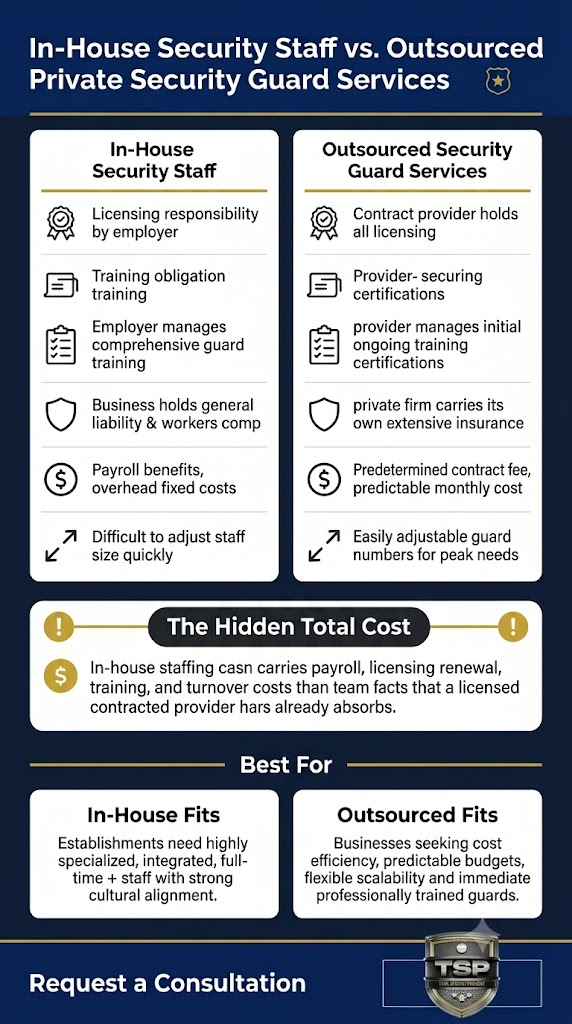
Quick Comparison: In-House Security vs. Outsourced Private Security Guard Services
The two options differ most on who carries licensing responsibility, how costs scale, and how much oversight the business must provide day to day.
| Criteria | In-House Security Staff | Total Service Provider (Outsourced) |
| Licensing responsibility | The employer registers and renews each guard’s license. | Handled entirely by the agency |
| Training obligation | The employer arranges and documents training. | Guards arrive pre-trained and certified. |
| Insurance and liability | The employer carries the exposure. | Bonded and insured coverage included |
| Cost structure | Fixed payroll, benefits, and overhead | Contract rate tied to actual coverage needed |
| Scalability | Slow to adjust staffing levels | Flexible short-term or long-term terms |
What Total Service Provider Does Best
Total Service Provider removes the licensing, training, and liability burden from the business by supplying guards who are already compliant with New York State requirements.
This matters because a single unlicensed guard incident can expose an employer to fines and civil liability that a licensed agency contract is built to prevent.
●Licensing and Compliance Handled for You
Every security guard operating in New York State must register and complete mandatory pre-assignment and on-the-job training under Article 7-A, according to the New York State Department of State.
When a business hires guards directly, it becomes the entity responsible for confirming that training, tracking renewal dates, and maintaining proof of compliance for each individual on staff.
Total Service Provider absorbs that entire process before a guard ever steps onto a client’s property, so the compliance risk never lands on the client’s desk.
●Military- and Law-Enforcement-Trained Personnel
Beyond compliance, the guards deployed carry military and law enforcement backgrounds, which shapes how they handle situations that generic security training does not fully prepare someone for, from de-escalating a conflict at a nightlife venue to managing entry points during a high-traffic event.
This is not a generic guard placement service. Every contract begins with a risk assessment specific to the site, followed by a security plan built around that assessment rather than a standardized package.
“We’ve relied on Total Service Provider for our office building security for years. Their team is punctual, disciplined, and consistently maintains a safe environment for our staff and visitors.” – David Reyes, Corporate Facilities Manager
●Contracts That Flex With Your Risk Level
That kind of consistency is difficult to replicate with an internal team unless the business already has dedicated security management staff.
Total Service Provider’s contracts also flex between short-term and long-term terms, so a retail client covering a seasonal risk period is not locked into the same commitment as a corporate office needing 24/7 coverage year-round.
Private security officer selection and training guidelines apply equally to proprietary in-house teams and contract security providers, according to ASIS International, the industry’s leading standards body.
The existence of a shared standard does not mean the burden of meeting it is shared equally. When a business outsources, the agency owns that standard. When a business staffs in-house, the business owns it alone.
What In-House Security Staffing Offers
In-house security means hiring guards directly as employees rather than through an agency. The business handles recruitment, wage and benefits administration, scheduling, and day-to-day supervision.
Guards report to internal management and typically work exclusively at one site, which can build familiarity with the building’s layout, tenants, or regular visitors over time.
The median annual wage for a security guard was 38,370 dollars in May 2024, according to the U.S. Bureau of Labor Statistics, and the employer is responsible for that payroll along with state licensing, training compliance, and liability coverage for each guard on staff.
Some businesses with an established HR department and a single, stable site manage this successfully for years.
The Key Differences That Matter
The visible cost difference between in-house and outsourced staffing is only part of the picture. The real gap shows up in compliance liability and total cost of ownership once training, licensing, and turnover are factored in.
●The Hidden Total Cost of Building an In-House Security Team
Most comparisons stop at hourly wage versus contract rate. A more complete picture includes the employer’s cost of Article 7-A registration.
And also renewal per guard, mandatory pre-assignment and on-the-job training hours, workers’ compensation exposure specific to security roles, and the cost of replacing and retraining staff when turnover happens.
About 162,300 security guard job openings occur every year nationwide, most of them driven by workers leaving the occupation rather than industry growth, according to the U.S. Bureau of Labor Statistics.
That turnover rate is a direct cost an in-house employer absorbs every time a guard needs to be replaced and retrained.
A contracted rate from a licensed provider already has these costs built into it, spread across the agency’s full guard roster rather than absorbed entirely by one employer, which is why the sticker price rarely tells the full story.
●Liability and Compliance Transfer
Yes, an in-house team gives a business direct day-to-day control over its guards, but that control comes with the employer holding full responsibility if a guard’s license lapses or training documentation is incomplete.
An outsourced contract shifts that specific liability to the licensed agency instead, along with the ongoing paperwork that keeps each guard compliant throughout the contract term.
Which Option Is Best For You?
In-house staffing best fits businesses with a single, stable site and an internal HR or compliance function already equipped to manage licensing, training, and liability without outside support and that have the time to build that capability from scratch.
Total Service Provider’s outsourced private security guard services best fit NYC businesses, event organizers, and property managers who want licensed, trained guards deployed without carrying the compliance and payroll burden themselves, especially across multiple sites, seasonal risk periods, or shifting operational needs.
Frequently Asked Questions
●Is it more cost-effective to hire in-house security or outsource it?
The answer depends on how many locations you manage and whether you already have staff who can handle licensing renewals and training documentation.
Businesses without that internal capacity typically find a contracted provider more cost-effective once compliance and turnover costs are factored in.
●Who is liable if an in-house security guard is unlicensed?
The employer holds that liability under New York State law, since Article 7-A requires the entity engaging the guard to confirm registration and training before deployment. This exposure does not exist the same way when a business contracts a licensed agency.
●Can outsourced security guards be customized to our building’s needs?
Yes. Total Service Provider builds each contract around a site-specific risk assessment rather than assigning a standardized guard package to every client.
●How fast can Total Service Provider deploy guards compared to hiring in-house?
Total Service Provider’s onboarding process moves considerably faster than recruiting, licensing, and training an internal team from scratch, since guards arrive already registered and trained under New York State requirements.
Wrapping Up!
The right choice depends on whether your business wants to own the compliance burden or transfer it. If you have the internal structure to manage licensing, training, and liability directly, in-house staffing can work for a single, stable site.
If you would rather have that responsibility handled by a team that already meets New York State’s requirements, outsourced private security guard services remove that weight entirely.
Request a consultation with Total Service Provider to get a security plan built around your specific site and risk level.