
When you search for asset protection services, you get many different answers. Every provider claims trained guards, and each one sounds equally ready. If you cannot tell the claims apart, you cannot compare the risk.
This article helps you choose between military-trained and standard-trained guards. It also shows what to require in writing before you sign.
Both types must meet New York’s registration rules, so the real difference lies in what you can verify, how guards perform under pressure, and how well the contract fits your facility.
Standard-trained guards suit posts that need only the state baseline, while military-trained guards suit high-risk, high-traffic sites where verified discipline matters.
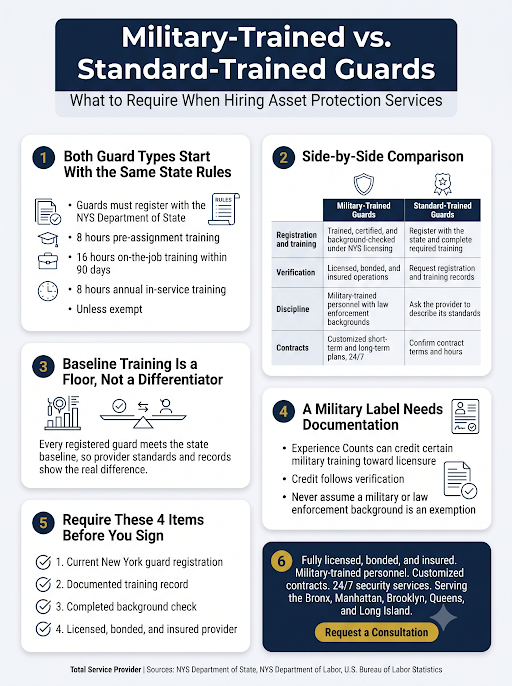
Military-Trained vs. Standard-Trained Guards
Every guard must hold state registration, so verification, discipline, and contract fit decide which option protects your assets better.
“Under Article 7-A, the New York State Department of State requires registered guards to complete eight hours of pre-assignment training, 16 hours of on-the-job training within 90 days, and eight hours of annual in-service training, unless exempt.”
| Criterion | Military-Trained Guards (Total Service Provider) | Standard-Trained Guards |
| State registration and training | Guards train, certify, and pass background checks under NYS Department of State licensing | Guards register with the state and complete required training |
| Document verification | Licensed, bonded, and insured operations you can verify | Request registration and training records |
| Discipline | Military-trained personnel with law enforcement backgrounds | Ask the provider to describe its standards |
| High-traffic readiness | Specialization in hospitality and nightlife security | Ask for venue-specific experience |
| Contract and coverage | Customized short-term and long-term plans with 24/7 coverage | Confirm contract terms and hours |
What Total Service Provider’s Military-Trained Guards Do Best
Total Service Provider places licensed, military-trained guards on customized contracts that protect your people, property, and assets around the clock.
To hire dependable security with confidence, require four items: current New York guard registration, a documented training record, a completed background check, and proof that the provider is licensed, bonded, and insured.
Then confirm that the contract matches your facility’s schedule and risk level. A provider that cannot supply all four items has not earned your contract.
Criterion 1: Licensed, Registered, and Background-Checked Guards
Total Service Provider holds a license from the New York State Department of State, Division of Licensing Services. The company trains, certifies, and background-checks its guards under those licensing requirements.
Fully licensed, bonded, and insured operations also give you documents to review before you sign. Still, verify each point yourself. Ask for the license, the insurance certificate, and the guard registration records before the first shift.
Criterion 2: Military-Trained Discipline in Asset Protection Services
Military-trained personnel with law enforcement backgrounds staff each post.
They bring disciplined professional standards to work that deters threats and controls access at office buildings, commercial properties, and retail spaces such as pharmacies, supermarkets, and jewelry stores.
Meanwhile, a military background supports discipline but does not replace verification, so you still confirm records. Contracts run short-term or long-term, follow your facility type, schedule, and risk level, and include 24/7 security services across every service line.
Criterion 3: Calm Authority in High-Traffic Venues
Hospitality and nightlife security is a core specialization. Guards manage crowds, resolve conflicts, and protect guest safety without disrupting the guest experience.
Crowd control and risk management add threat assessment and rapid incident response for busy venues and large gatherings.
James Carter, a Hospitality & Nightlife Security client, describes the result:
“Their hospitality security team is exactly what our venue needed. They’re experienced, calm under pressure, and handle every situation with the right level of authority and professionalism.”
What Standard-Trained Guards Offer
Standard-trained guards register with the Department of State and complete the state-required training, unless an exemption applies. They can staff posts that call for the state baseline and nothing more.
Their main strength is that they meet the legal minimum, which gives you a clean starting point for comparison.
Yes, that baseline is a real strength. But every registered guard meets it, so it does not show how a provider screens, supervises, or deploys its people. Their records and the provider’s written standards become the deciding evidence, so request both before you compare schedules.
The Key Differences That Matter
State training sets the floor for every guard, and documentation shows how far above that floor a guard actually stands.
Difference 1: Baseline Training Is a Floor, Not a Differentiator
Yes, standard-trained guards meet the state baseline. But every registered guard meets that same baseline, so it cannot separate one provider from another.
“The U.S. Bureau of Labor Statistics lists a high school diploma or equivalent as the typical entry-level education for security guards.” Entry requirements set a low starting point across the field, so a provider’s own standards and records show the real difference.
Difference 2: “Military-Trained” Is a Label; Documentation Is the Requirement
Military training carries real value, yet the label alone proves nothing to a licensing office.
“The New York State Department of Labor states that its Experience Counts program recognizes certain military training as credit toward licensure for veterans who become armed and unarmed security guards.
Once qualifying military training is verified, New York State Department of Labor staff can assist a veteran with the program.”
Credit, therefore, follows verification, so ask any provider which records back its claim. Never assume a military or law enforcement background exempts a guard from required training.
Which Option Is Best for Your Asset Protection Services?
Standard-trained guards suit buyers who need only the state baseline at a low-risk post and who verify each provider’s standards and records before signing.
Total Service Provider suits NYC business owners, operations managers, and event planners who need documented, licensed, bonded, and insured coverage for offices, retail spaces, restaurants, bars, or public events, with military-trained discipline and 24/7 protection.
Frequently Asked Questions (FAQs)
These answers cover the questions buyers ask most before they sign a security contract.
Q1. What training does New York require for a security guard?
Registered guards complete eight hours of pre-assignment training, 16 hours of on-the-job training, and eight hours of annual in-service training, unless an exemption applies.
Total Service Provider trains, certifies, and background-checks its guards under those licensing requirements. Ask your provider for each guard’s records before the first shift.
Q2. Does military service replace state guard training?
No. Certain military training can earn credit toward state licensing through the Experience Counts program, but only after qualifying training is verified. Ask the provider documents support each guard’s military claim, and confirm registration separately.
Q3. What documents should you ask a security company for?
Request the company’s New York license, its bond and insurance certificates, and guard registration and training records.
Q4. Can you choose short-term or long-term security contracts?
Yes. Contract-based plans run short-term or long-term and follow your facility type, schedule, and risk level.
Q5. Does Total Service Provider offer 24/7 security?
Yes. The company delivers 24/7 security services across all service lines, from corporate and commercial security to crowd control and risk management.
The Bottom Line
Start with four requirements: guard registration, training records, background checks, and a licensed, bonded, and insured provider. Ask each company on your shortlist to document all four before you sign.
Total Service Provider designs customized, contract-based asset protection services for offices, retail spaces, hospitality venues, and events across the Bronx, Manhattan, Brooklyn, Queens, and Long Island.
Request a consultation with Total Service Provider for a customized security proposal for your facility.