
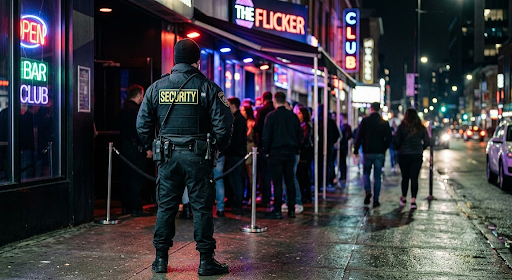
One club owner hired the cheapest security team he could find. Within three months, an unlicensed guard started an altercation that led to a lawsuit and a suspended liquor license.
Another operator two blocks away chose a nightlife security NYC firm that could prove its licensing, training, and contract terms before the ink dried. A year later, one business was still open. The other was not.
The difference came down to what the owner checked before signing!
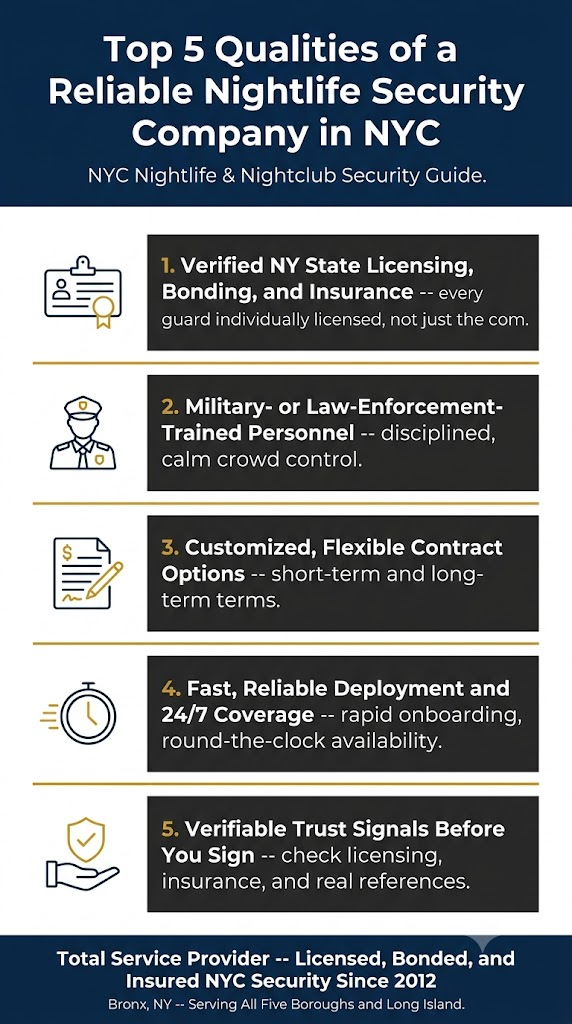
The right nightlife security NYC provider protects your liquor license, your guests, and your liability exposure, not just your door. Here are the five qualities that separate a dependable firm from a risky one.
How These Qualities Were Selected
Each quality below reflects a real decision factor NYC business owners weigh before signing a security contract, not a generic feature list.
- Direct exposure to legal and liability risk if guards are unlicensed or undertrained
- The need for coverage that flexes with changing event schedules and risk levels
- Verified licensing, bonding, and insurance status as a non-negotiable baseline
- Proven crowd-management experience in high-traffic nightlife settings
- The ability to confirm claims before signing, not just take them at face value
Demand for trained, licensed protection is rising: the global private security market reached an estimated USD 261.70 billion in 2025 (Fortune Business Insights Private Security Market Report, 2025).
1. Verified New York State Licensing, Bonding, and Insurance
A reliable firm can show that every individual guard, not just the company, is licensed under New York State requirements.
●What It Is and What It Does
New York State requires every security guard to hold an individual license through the Division of Licensing Services, separate from the company’s own license.
The Total Service Provider maintains active licensing, bonding, and insurance for every deployed guard under this NY State framework. This protects a business’s liability position if a guard is involved in an incident on the premises.
Venues should maintain at least one trained, licensed guard once patron counts reach a moderate threshold.
As of May 2025, NYPD had filed 171 safety and compliance referrals to the NYC Office of Nightlife Annual Report, 2025, with 97 more from other agencies; the same report notes a single noncompliant venue could face up to USD 10,000 in fines during one multi-agency inspection.
●Best For
Owners who need direct proof of liability protection before an incident occurs, not after.
●One Honest Limitation
Licensing confirms a guard is legally permitted to work the door. It does not confirm how that guard performs under pressure, which is why training history matters just as much.
2. Military- or Law-Enforcement-Trained Personnel
Guards with military or law-enforcement backgrounds bring disciplined, situational-awareness-driven conduct to high-conflict nightlife environments.
●What It Is and What It Does
Crowd conflict in a nightclub rarely looks like a textbook scenario. It escalates fast, involves alcohol, and often needs de-escalation before it needs physical intervention.
Guards trained in military or law-enforcement settings learn to read a room before a situation turns physical, not just react once it already has.
James Carter, a nightclub operations director who works with Total Service Provider, describes the difference directly: “Their hospitality security team is exactly what our venue needed. They’re experienced, calm under pressure, and handle every situation with the right level of authority and professionalism.”
Venues with visible, trained security staff report lower rates of violence and higher patron confidence in venue safety.
●Best For
Nightclubs and lounges that experience frequent crowd density or recurring conflict, especially on high-traffic nights.
- One Honest Limitation
Training quality varies between firms even within the same licensing category. Ask how guards are vetted and trained before deployment, not just whether they are licensed.
3. Customized, Flexible Contract Options
A reliable firm offers both short-term and long-term contract terms priced around the business’s actual risk level, not a fixed package.
●What It Is and What It Does
Nightlife businesses do not have static security needs. A weekend event night carries different risk than a slow Tuesday.
Short-term event coverage paired with long-term standing contracts lets an operator scale staffing up or down instead of overpaying for coverage it does not need. Total service provider prices for every contract are around facility type and risk level, not a one-size-fits-all rate card.
●Best For
Businesses with variable event calendars, seasonal nightlife traffic, or a mix of private events and regular nights.
- One Honest Limitation
Customized pricing means there is no advertised flat rate. Expect a short risk assessment before receiving a firm quote, not an instant number over the phone.
4. Fast, Reliable Deployment and 24/7 Coverage
A dependable firm can move from risk assessment to guard deployment quickly, with coverage available around the clock.
●What It Is and What It Does
A business that loses a guard last minute or opens a new location needs a firm that can respond in days, not weeks.
Total Service Provider runs a fast onboarding process and staffs its crowd control and risk management service around the clock, closing coverage gaps before they start. This matters most for nightlife, since incidents are more likely during late-night hours after standard daytime security coverage has ended.
●Best For
Businesses opening a new location, filling an unexpected coverage gap, or running events outside standard daytime hours.
- One Honest Limitation
Fast deployment still requires a completed risk assessment first. Same-day staffing with no process behind it skips a step that usually causes problems later, so a firm offering it without an assessment is cutting a corner.
5. Verifiable Trust Signals Before You Sign
Ask for proof, not promises: licensing documentation, insurance certificates, and real client testimonials before you sign anything.
●What It Is and What It Does
Most guidance on hiring nightlife security focuses on staffing ratios and guard roles. Fewer sources walk an owner through verifying a firm’s claims before committing to a contract.
A simple pre-signing checklist closes that gap: request the guard licensing roster, ask to see proof of current insurance and bonding, and ask for a reference from a similarly sized business.
A company confident in its own compliance produces these documents without hesitation.
Citywide, only five nightlife venues showed significant non-cooperation and faced a follow-up inspection between 2024 and 2025 (NYC Office of Nightlife Annual Report, 2025); most avoid that outcome by following basic security recommendations.
●Best For
Owners comparing multiple quotes who need a concrete way to shortlist candidates, not just a gut feeling.
●One Honest Limitation
A documentation checklist narrows the field. It does not replace an in-person risk assessment of your property, which should still happen before any contract is finalized.
Frequently Asked Questions
●How do I verify a nightclub security company’s license in NYC?
Ask the firm for the individual license numbers of the guards assigned to your property, then confirm them through the New York State Division of Licensing Services. A reliable company will not hesitate to share this information.
●How many security guards does a nightclub need in NYC?
Staffing depends on patron capacity, layout, and event type. A licensed firm will run a risk assessment specific to your business rather than quoting a number before seeing the space.
●Can nightclub security contracts be short-term?
Yes. Many firms offer short-term coverage for single events alongside long-term contracts for ongoing operations, so an owner is not locked into a package that does not match the schedule.
●What happens if a nightclub uses unlicensed security guards?
An unlicensed guard creates direct liability exposure for the business if an incident occurs, and it can also put a liquor license and permits at risk during a review.
●Do security guards need special training for nightlife businesses?
Nightlife settings involve alcohol, dense crowds, and fast-moving conflict, which is why guards with law-enforcement or military-style de-escalation training tend to perform more consistently than generalist staff.
Conclusion
Choosing the right nightlife security provider in NYC involves more than filling the door on a Friday night. Your liquor license, your guests, and your liability position all depend on the guards on site every night. Before signing, confirm individual guard licensing, ask about training background, review contract flexibility, and request real references.
Contact Total Service Provider for a risk assessment and a customized security plan built around your business’s patron volume and schedule.