
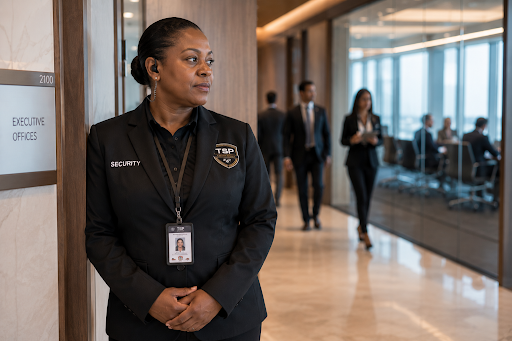
When you compare guard proposals in NYC, every option promises licensed guards and 24/7 coverage, and the answers start to sound alike.
A promise of coverage does not explain how anyone checks the post once the shift starts. If you cannot tell which option to trust, start with one question: does anyone supervise the post?
This guide compares supervised and unsupervised guard posts so you can match the model to your building, your shifts, and your liability exposure.
The short verdict: choose a supervised post for long shifts, overnight hours, or high foot traffic, and write the oversight terms into your corporate security services contract.
Unsupervised posts suit small, low-risk, short-term sites. Supervised posts suit NYC offices, commercial properties, and retail spaces that need documented, accountable coverage.
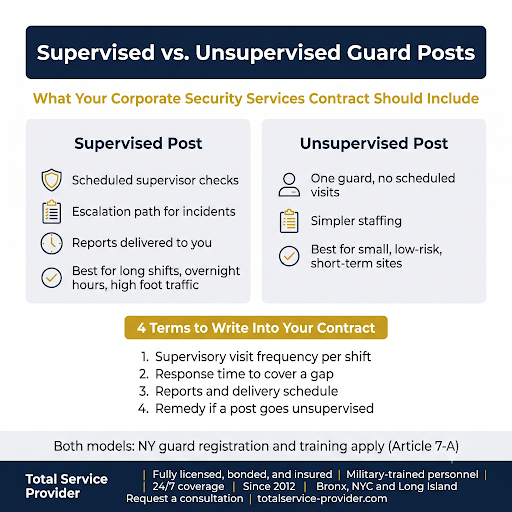
Supervised vs. Unsupervised Guard Posts
A supervised post adds scheduled checks and escalation to the guard’s own duties, while an unsupervised post relies on the guard alone.
| Criterion | Supervised post | Unsupervised post |
| Coverage consistency | A supervisor checks that the post stays staffed and on task | The guard alone keeps the post running |
| Overnight and weekend shifts | After-hours posts gain scheduled checks | After-hours posts rely on the guard alone |
| Guard absence | The contract can set a coverage-gap response time | Coverage depends on general scheduling |
| Contract flexibility | Oversight terms scale with short-term or long-term needs | Simple terms, fewer oversight options |
| Licensing and insurance | Verify the provider’s license, bond, and insurance | Verify the provider’s license, bond, and insurance |
What Total Service Provider Offers in Corporate Security Services
Total Service Provider combines licensed, bonded, and insured protection with military-trained personnel and tailored contracts, so you can set oversight terms that match your site.
Total Service Provider is a fully licensed, bonded, and insured security guard company in the Bronx, operating since 2012.
It provides corporate security services and commercial security across NYC and Long Island, with military-trained guards, 24/7 coverage, and customized contract-based plans that run short-term or long-term.
Fully Licensed, Bonded, and Insured Accountability
Liability sits at the top of your checklist, so your contract should answer it first. The Total Service Provider holds its license under the New York State Department of State, Division of Licensing Services.
Its guards meet New York State Department of State licensing requirements, including training, certification, and background checks. As a result, insurance and bonding stand behind the guard when a post fails.
Military-Trained, Disciplined Personnel With 24/7 Coverage
Total Service Provider staff posts with military-trained personnel who bring law enforcement backgrounds and disciplined professional standards. In addition, round-the-clock coverage gives your overnight and weekend shifts the same standard as weekday hours.
David Reyes, a Corporate Security and Commercial Security client, describes the working relationship:
“We’ve relied on Total Service Provider for our office building security for years. Their team is punctual, disciplined, and consistently maintains a safe environment for our staff and visitors.”
Customized Contract Terms for Field Oversight
A guard description is not a contract term. When you request tailored guard coverage, bring four oversight terms to the table.
- First, set the supervisory visit frequency per shift.
- Second, set a response time for covering an unsupervised post or a guard absence.
- Third, define which reports you receive and when.
- Fourth, state the remedy if a post goes unsupervised.
Total Service Provider builds plans around each client’s facility type, schedule, and risk level, with short-term and long-term agreements. Therefore, use these four terms as your agenda for that conversation.
What Unsupervised Posts Offer
Unsupervised posts keep staffing simple and suit small, low-risk, short-duration sites.
They place one guard at the site with no scheduled supervisory visits. They need less coordination, and they fit a single-entrance location with limited foot traffic.
Yes, the structure is simpler, but the guard then carries every judgment call alone, and you absorb the gap if a shift goes wrong.
However, registration and training do not change with this choice.
“The New York State Department of State states that Article 7-A, sections 89-g, 89-h, and 89-n, require every person engaged in security guard activities to register and complete required training, unless exempt.”
Supervision adds a layer on top of that baseline.
The Key Differences That Matter for Your Site
Two differences drive most contract decisions: how consistently a post stays covered and whether oversight appears in writing.
Difference 1: Coverage Consistency Over Long Shifts
Yes, an unsupervised post takes less coordination, but long and overnight shifts can leave a single guard without a second check.
A supervised post adds a scheduled review that confirms a guard stays at the post, stays alert, and follows site orders. For a 24/7 office or retail location, that review supports the consistent coverage you expect.
Difference 2: A Described Oversight vs. A Written Contract Term
Yes, a provider may describe supervision as part of its service, and that description has value. However, a description does not give you a measurable obligation. Ask for measurable terms in writing. Written terms let you hold a provider to its promise.
Which Option Is Best for Your Corporate Security Services Contract?
Match the model to your site’s hours, traffic, and liability exposure.
Unsupervised Post
Best for single-guard, low-traffic, short-duration sites with minimal after-hours risk, where an incident would carry limited consequences.
Supervised Post
Best for NYC operations managers and property managers responsible for office buildings, commercial properties, or retail spaces who need documented, accountable coverage and want oversight terms written into their contract.
Frequently Asked Questions (FAQs)
Buyers ask these questions most before they sign.
Q1. What is a supervised guard post in corporate security services?
A supervised guard post is an assignment where a supervisor checks the guard on a schedule, confirms the post stays staffed, reviews reports, and handles escalations. That adds a second layer of accountability to the guard’s own duties. You set the visit frequency in your contract.
Q2. What field oversight terms should a contract include?
Specify four terms: supervisory visit frequency per shift, response time to cover an unsupervised post or guard absence, the reports you receive and when, and the remedy if a post goes unsupervised. Written terms turn a promise of oversight into an obligation you can enforce.
Q3. Can you add oversight terms to a short-term guard contract?
Yes, you can ask for oversight terms in any contract, short-term or long-term. Total Service Provider offers both agreement lengths, so raise your terms when you request a proposal.
Q4. Must New York security guards register and complete training?
Yes, with limited exceptions.
“The New York State Senate publishes Article 7-A, the Security Guard Act, covering guard employment in section 89-g and registration cards in section 89-h.”
“The NYS Division of Criminal Justice Services adds that guards take the initial state courses only once, though a new employer decides whether to require a retake.”
Q5. What documents should you request before signing?
Request the provider’s New York State Department of State license, its certificate of insurance, and its bond documentation, plus proof of each guard’s registration and training.
Final Thoughts
Before you sign any corporate security services contract, ask each provider how it checks the post, how fast it covers a gap, and which reports you will receive. Then put the answers in writing.
Total Service Provider has served NYC businesses since 2012 as a fully licensed, bonded, and insured security guard company, with military-trained personnel and 24/7 coverage.
Request a consultation with Total Service Provider to discuss a customized security plan for your site and your shift schedule.