
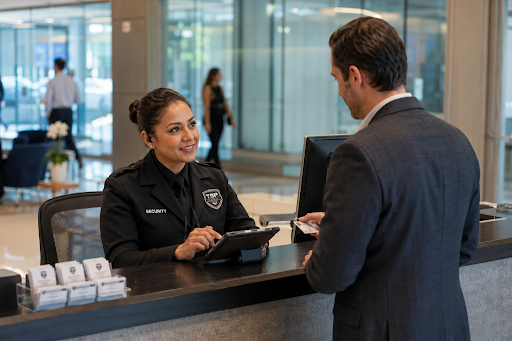
Contract guards suit pharmacies, supermarkets, and clothing or jewelry stores that want licensed, bonded, and insured coverage on flexible terms.
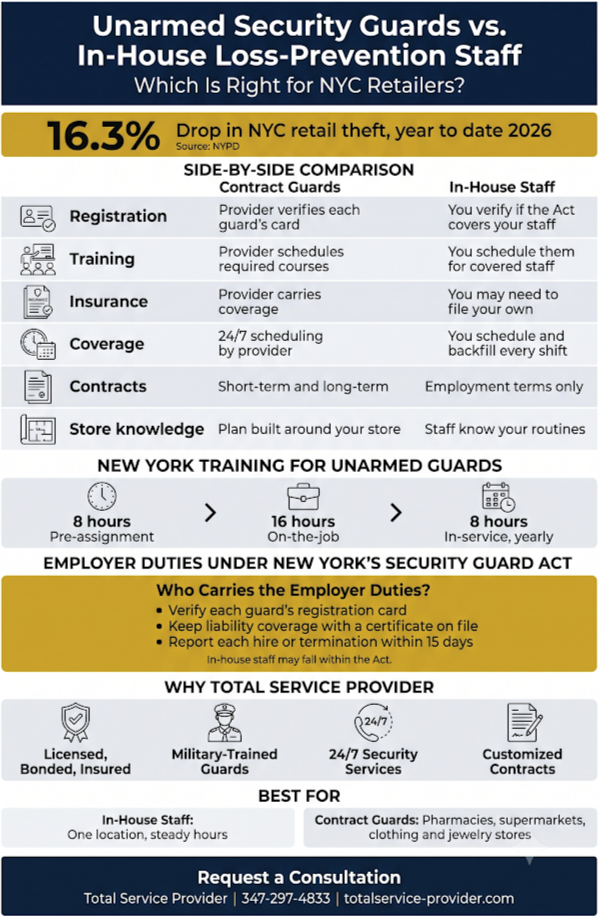
Contract Guards vs. In-House Teams
The two options differ most in who handles registration, training, insurance, and scheduling.
| Criterion | Contract guards | In-house loss-prevention staff |
| Registration duties | The provider verifies each guard’s registration card | You verify cards if the Act covers your staff |
| Training duties | The provider schedules eight-hour, 16-hour, and annual courses | You schedule them for covered staff |
| Insurance certificate | The provider carries coverage and files its certificate | You may need to file your own |
| Coverage hours | Provider schedules 24/7 coverage | You schedule and backfill every shift |
| Contract flexibility | Short-term and long-term agreements | Employment terms, no contract term |
| Customer contact | Plan built around store hours and risk | Staff know your store and routines |
What Total Service Provider Does Best With Unarmed Security Guards
Total Service Provider gives NYC retailers registered, background-checked guards, guest-friendly enforcement, and contracts that match your schedule.
Total Service Provider supplies fully licensed, bonded, and insured unarmed security guards to NYC retail stores, including pharmacies, supermarkets, and clothing and jewelry stores.
The company trains, certifies, and background-checks each guard under New York State Department of State requirements. Coverage runs 24/7 on customized short-term or long-term contracts.
Criterion 1
Registered Guards Under a Licensed, Bonded, and Insured Provider Registration comes first, because a guard without it cannot legally work your floor.
According to the New York State Department of State, “unarmed guards complete eight hours of pre-assignment training, 16 hours of on-the-job training within 90 days of employment, and eight hours of in-service training each calendar year.”
Next, consider the provider behind the guard. Total Service Provider holds its license from the Department of State, Division of Licensing Services, and has protected NYC properties since 2012. Its bonded and insured status speaks directly to your liability concerns.
Also, because every guard holds state registration, you avoid the gap that appears when an unregistered hire covers a shift. The on-the-job course also covers the duties, work site requirements, and employer needs of each post.
Day to day, your guards deter threats, control access, and maintain a safe environment for shoppers and staff. Verification matters, so ask every provider to show each guard’s registration status before the first shift.
Criterion 2
Customer Experience Without Weaker Enforcement A guard who challenges every shopper harms the visit, and a guard who ignores the door harms the store.
Military-trained personnel with law enforcement backgrounds bring disciplined, calm authority to that balance.
A hospitality client describes the same balance on a busy venue floor:
“The Total Service Provider has been outstanding for our venue. Their guards are professional, well-trained, and know exactly how to manage our crowd without disrupting the guest experience.” —Marcus Allen, Hospitality and Nightlife Security client.
Retail floors share that guest-facing pressure, and your staff benefit too, because visible, disciplined coverage supports a safe working environment at registers and stockroom doors.
Your customers notice the difference between a guard who greets and one who hovers. Posture matters as well, because visible, communicative guards deter theft without stopping every purchase. Ask any provider how its guards train for both.
Criterion 3
Customized Short-Term and Long-Term Contracts Many buyers hesitate over rigid security agreements. Total Service Provider offers short-term and long-term contracts instead of one fixed package.
The company customizes each plan around your facility type, schedule, and risk level, so coverage matches how your store actually operates.
A pharmacy with late hours and a supermarket with morning deliveries need different schedules, and your contract reflects that difference. Customized plans let your security match your store as its hours and risk profile change, and they keep the focus on the decision you actually face:
How many hours do you need, at which posts, and for how long?
Short-term terms suit a seasonal promotion or a new store opening, while long-term terms suit steady daily coverage. For unarmed security guards at your entrances, 24/7 services stay available across every service line, so extended hours stay within one provider’s scope.
Learn more about Corporate Security and Commercial Security for retail spaces.
What In-House Loss-Prevention Staff Offers
In-house teams give you direct employment and store familiarity, with every scheduling and compliance task on your side.
In-house teams employ loss-prevention staff directly and supervise them day to day. Yes, that structure gives them close store knowledge, but they carry every hiring, training, and scheduling task themselves.
Their managers also set shift patterns around their own headcount. Yes, that control suits steady single-location hours, but it means they arrange backup for every absence and every vacancy.
In short, their model works well when a retailer has a stable schedule and the capacity to manage employer duties internally.
The Key Differences That Matter
The key differences can be seen in how each model approaches theft prevention, response, and overall security.
Difference 1
Store Familiarity vs. Coverage Continuity Yes, in-house staff learn your layout quickly, but your own schedule and backfill decide whether every shift has coverage. A contract provider schedules 24/7 services.
Difference 2
“Who Carries the Employer Duties Under New York’s Security Guard Act: New York General Business Law Section 89-f defines a security guard company as any employer of guards on a proprietary basis for its own use or on a contractual basis.”
Loss-prevention staff employed principally to protect property from theft may fall within the Act.
“Section 89-g requires employers to verify each guard’s registration card, keep liability coverage with a certificate on file, and report each hire or termination within 15 calendar days.”
However, the statute excludes companies that use guards solely for their own proprietary use from its Article 7 enforcement provisions, so confirm your status with the Department of State or counsel. Yes, in-house staffing gives you direct control, but it may make you the responsible employer.
Which Option Is Best for You?
Choose by your store’s hours, number of locations, and capacity to manage employer duties.
Choose in-house loss-prevention staff if you run one location with steady hours and already manage payroll, training records, and insurance filings.
Choose contract guards if you operate a pharmacy, supermarket, or clothing or jewelry store in the five boroughs or Long Island and want coverage matched to your schedule.
Total Service Provider has served over 1,000 satisfied clients across 24+ industries.
Frequently Asked Questions (FAQs)
Q1. Is the Total Service Provider licensed, bonded, and insured?
Yes. Total Service Provider operates as a fully licensed, bonded, and insured provider under New York State Department of State licensing. The company trains, certifies, and background-checks every guard under those requirements, and coverage runs 24/7 across every service line.
Q2. How long can a retail security contract run?
Total Service Provider offers short-term and long-term agreements. The company customizes each plan around your facility type, schedule, and risk level, and 24/7 coverage applies under either term for retail locations such as pharmacies and supermarkets.
Q3. Can you combine contract guards with in-house loss-prevention staff?
You can. A customized plan can assign contract guards to entrances and peak hours while your staff keeps store routines.
Q4. Which NYC areas does Total Service Provider cover for retail?
Coverage spans the Bronx, Manhattan, Brooklyn, Queens, and Long Island. Retail clients include pharmacies, supermarkets, and clothing and jewelry stores.
Q5. What should you ask a provider before signing a retail guard contract?
Ask how the provider verifies each guard’s registration, schedules required training, and carries liability coverage. Those match the employer duties covered above.
Final Words
Your store needs coverage that protects shoppers, staff, and inventory without turning customers away. Unarmed security guards from a licensed, bonded, and insured provider deliver that coverage, and the provider carries the employer duties for the guards it places.
Start with a short-term contract if your hours are still changing, or choose a long-term plan for steady daily coverage.
Request a consultation with Total Service Provider to review your store hours, risk level, and contract term, and receive a customized security proposal for your NYC location.