

Office buildings face daily risks from unauthorized access, workplace incidents, and after-hours activity. Corporate security guards help manage these risks through access control, visitor screening, patrols, and incident response.
In this article, you’ll learn what to look for in a licensed security provider, how coverage can match your building’s risk level, and what to verify before signing a contract.
Quick Answer: Licensed corporate security guards help protect NYC office buildings through access control, incident response, and security coverage tailored to the property’s needs.
Corporate Security Guards, Simply Explained
Quick Answer: Corporate security guards are licensed professionals who control access, deter incidents, and maintain a safe environment inside commercial office buildings.
●Core Definition in Plain Language
A corporate security guard is a state-licensed professional assigned to protect an office building, its employees, and its visitors. In New York, every guard must complete pre-assignment and annual in-service training before deployment, a requirement set by the New York State Department of State.
This licensing step exists because untrained personnel cannot legally perform guard duties. Building owners who skip verification carry that compliance risk themselves, even when a third-party contractor supplies the guard.
●How It Works in Practice
Day to day, a corporate security guard checks visitor credentials, monitors entry points, and responds to incidents before they escalate.
In practice, a corporate security guard controls who enters an office building, verifies visitor identity at the front desk, monitors camera feeds where installed, and documents every incident in a shift report that building management can review.
This routine work is what prevents small access failures from becoming major security breaches.
Guards also coordinate with building management to adjust coverage during high-traffic periods, such as morning arrivals or after-hours access, and they flag recurring issues so the security plan can be adjusted before a pattern turns into an incident.
Why Corporate Security Guards Matter to NYC Office Buildings
Quick Answer: Skipping licensed security exposes a building to legal liability and preventable incidents, while professional coverage reduces both risks at once.
●The Cost of Skipping Licensed Security
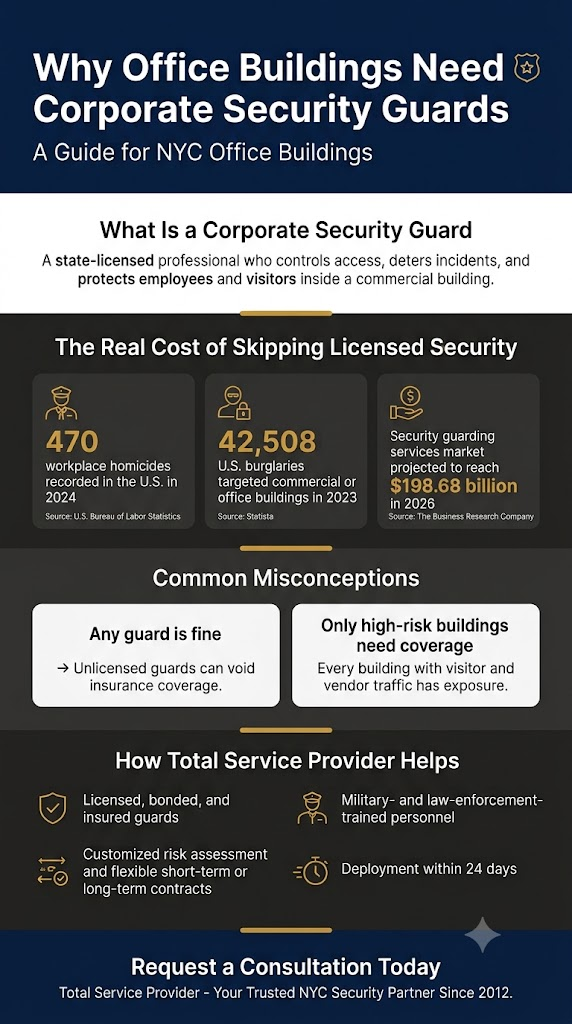
The financial and legal cost of unlicensed security is not theoretical. The Bureau of Labor Statistics recorded 470 workplace homicides in 2024, up from 458 the year before, a reminder that violent incidents inside commercial buildings remain a real and rising risk.
Break-ins compound that exposure: 42,508 burglaries in the United States targeted commercial or office buildings in 2023, according to Statista, making unsecured access points a documented, not hypothetical, risk. Hiring an unlicensed guard adds a second layer of exposure.
In Najjar Abdullah v. Inspire Brands, Inc. (Wis. Ct. App. 2024), an employer that used a guard without the required security license faced a negligent hiring claim, and the insurer moved to deny coverage over the licensing gap.
A single unlicensed placement can cost a building far more than the guard’s hourly rate.
●What a Building Gains From Professional Coverage
A properly licensed guard team gives an office building three things at once: verified compliance with New York State Department of State requirements, a documented, insurance-eligible security program, and a visible deterrent that reduces incident frequency.
New York State also requires the employer of a security guard company to confirm liability insurance coverage before deployment (NYS Department of State), which protects the building financially if an incident does occur.
Demand for that kind of coverage keeps rising, with the U.S. security guarding services market projected to grow from 184.33 billion dollars in 2025 to 198.68 billion dollars in 2026, according to The Business Research Company, a sign that more building owners treat professional coverage as standard, not optional.
Common Misconceptions About Corporate Security Guards
Quick Answer: Two assumptions cause the most costly security mistakes: treating all guards as interchangeable and assuming only high-risk buildings need coverage.
●Misconception 1: Any Guard Is Fine, Licensing Doesn’t Matter
Some building managers assume a guard is a guard, regardless of licensing status.
New York law says otherwise: security guard activity without a current license is not a paperwork formality; it is a compliance failure that can void insurance coverage after an incident. Verifying an active license before deployment protects the building, not just the guard.
This check takes only a few minutes through the state registry, yet it is the single most overlooked step in a rushed hiring decision.
●Misconception 2: Only High-Risk Buildings Need Coverage
Other managers assume a quiet office building has no need for security. Every commercial building with employee and visitor traffic has access points that need control, deliveries that need verification, and after-hours periods when no staff is present to respond to an incident.
Risk depends on exposure, not industry type. A building with a steady flow of vendors, contractors, and after-hours tenants carries real access risk even without a history of serious incidents.
How Total Service Provider Helps With Corporate Security Guards
Quick Answer: Total Service Provider builds a customized security plan around your building’s risk profile, then deploys licensed guards on a contract that scales as your needs change.
●A Security Plan Built Around Your Building’s Risk Profile
Total Service Provider does not sell a single fixed package. Every engagement starts with a risk assessment specific to the building, its access points, and its traffic patterns, then moves into a security plan built around that assessment. Coverage is available on a short-term or long-term contract.
A building can scale guard presence up during a renovation, a lease transition, or a seasonal traffic spike and then adjust back down once the risk changes. This flexibility is what separates a customized security plan from a one-size-fits-all guard placement.
●What Total Service Provider’s Process Looks Like
Once a plan is approved, Total Service Provider deploys licensed, military- and law-enforcement-trained guards within 24 days of onboarding.
David Reyes, a Corporate Facilities Manager who has used the service, describes the result directly: “We’ve relied on Total Service Provider for our office building security for years. Their team is punctual, disciplined, and consistently maintains a safe environment for our staff and visitors.”
That kind of consistency is the outcome a documented, risk-based process is built to deliver.
Frequently Asked Questions
●Do office buildings in NYC legally need licensed security guards?
New York does not require every office building to hire guards, but any guard hired must hold an active state license. Unlicensed guards risk denied insurance coverage and negligent hiring claims after an incident.
●How much does it cost to hire corporate security guards for an office building?
Total Service Provider prices each engagement by facility type, risk level, and schedule, not a fixed package.
●How fast can a security guard company deploy guards to a new building?
Total Service Provider completes a risk assessment and deploys licensed, trained guards within 24 days of onboarding, fitting both emergency and planned contract starts.
●Can office buildings choose short-term security coverage instead of a long-term contract?
Yes. Coverage can run as a short-term or long-term contract, so a building can scale guard presence up during a risk period and down once it ends.
●What should a building manager check before hiring a corporate security guard company?
Verify the company’s state license, confirm liability insurance, and ask how guards are trained. A risk-assessment-based plan fits your building better than a generic package.
Protect Your Office With the Right Security Team
Corporate security guards help NYC office buildings control access, manage risks, and protect employees and visitors. Total Service Provider provides licensed security services tailored to your building’s needs across the Bronx, Manhattan, Brooklyn, Queens, and Long Island.
Contact Total Service Provider today to discuss your corporate security needs and request a tailored security assessment.